Summary sheet
A short reviewer-facing view of what happened, what is included, and where the proof path starts.
Turn scattered operational records into a receiver-ready proof path.
Vraimony organizes delay, change, acceptance, and dispute records into a summary sheet, proof card, structured bundle, structured data export (JSON / ERF), and a read-only verification path. This reduces repeated explanation and makes sender, receiver, and third-party review easier while keeping the public surface focused on receiver-ready packaging rather than abstract trust jargon.
A short reviewer-facing view of what happened, what is included, and where the proof path starts.
A compact handoff object that makes the proof path easier to identify and share.
The cleaner package that groups records, notes, and references into one review-ready path.
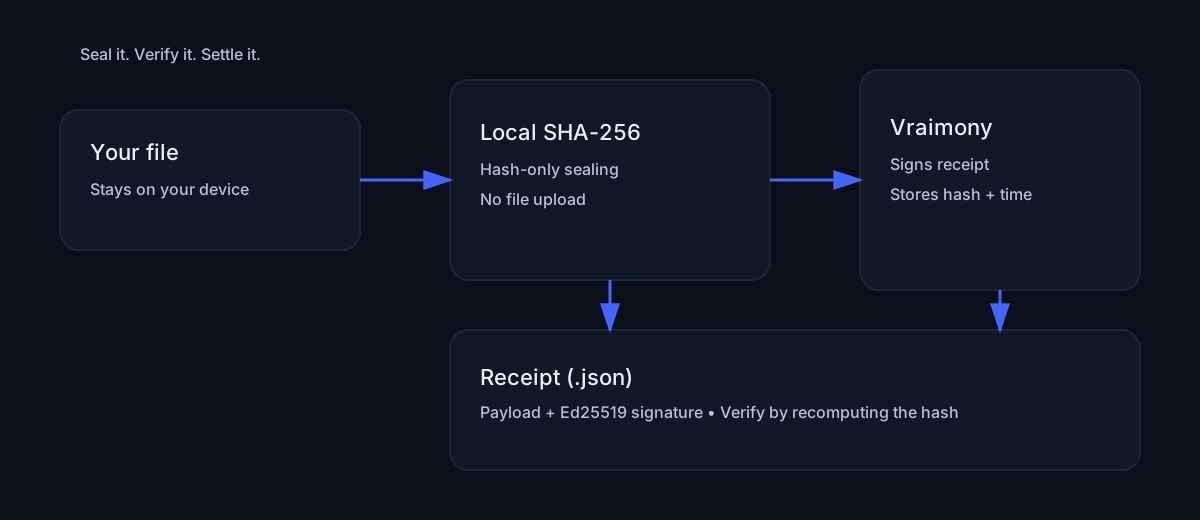
Portable evidence output, powered by Vraimony ERF.
A bounded inspection path for reviewers who need to check integrity and reference state without workflow lock-in.
Stop rebuilding the same context across chat, email, and attachments.
Review the summary first, then inspect the references only when needed.
Reuse the same proof path for escalation, procurement, insurance, audit, or partner review when relevant.
Keep acceptance, correction, or missing-item follow-up closer to the same package story.
Start from the records you already have: order updates, delivery notes, approvals, submissions, handoff messages, or review timestamps.
Turn those records into a summary sheet, proof card, structured bundle, structured data export (JSON / ERF), and a read-only verification path that are easier to review and explain.
Use one cleaner proof path for review, handoff, or dispute follow-up, with a read-only verification path where inspection helps.
Use it for: giving a reviewer the short version first.
What it looks like: one sheet with the key identifiers, timestamps, and review notes.
Use it for: quick handoff, simple reference, and cleaner sharing.
What it looks like: a compact proof object that points to the structured path.
Use it for: portability, JSON-style export, and reuse across tools or reviewers.
What it looks like: a receipt-style structured data layer with identifiers, hash references, and signature metadata.
It helps prove: integrity and proof structure. It makes the path cleaner to review, share, and inspect.
A verify result is not a promise about identity, truth, legal admissibility, delivery condition, or business outcome. Source and context still matter.
It does not prove: authorship, intent, ownership, grading outcome, legal admissibility, or delivery performance by itself.